
If you noticed a sudden, sharp drop in your Google Search Console impressions around mid-September, you’re not alone. It was a change felt across the industry, and our SEO team has broken down exactly what we witnessed and what it means.
The Global Effect of &num=100
As SEO specialists at Conversion Marketing, we spend a significant amount of time monitoring our clients’ Google Search Console (GSC) data. Typically, these metrics align with recent algorithmic changes or adjustments made to a client’s site as part of regular SEO optimisation.
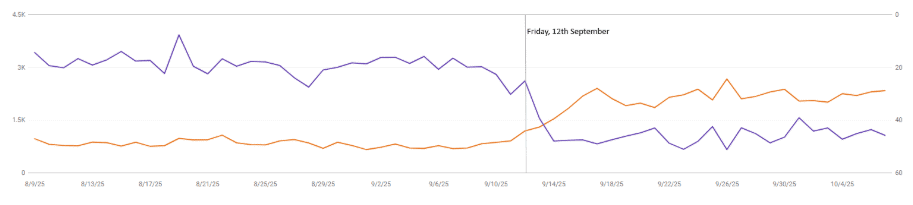
In mid September, we stumbled upon some confusing data (sharp drops in impressions accompanied by increases in average position across all of our clients’ sites). The skewed metrics we were seeing were enough to make any client feel uneasy or even panic.
True to our role, we did some digging and discovered this was an event affecting the entire SEO world. Our industry was buzzing about what looked like a performance issue. However, we soon found out it was due to Google’s removal of the &num=100 search parameter. This is a feature heavily relied upon by rank tracking tools.
The “lost” impressions were not from human searchers. Their removal has greatly changed the data landscape for the better.
Details of the sudden, global drop in search impressions
Starting around September 10th, websites worldwide noticed a big drop in impressions shown in Google Search Console (GSC). According to an article from Search Engine Journal on September 18th, Danny Goodwin reported that:
- 87.7% of websites lost impressions
- 77.6% of websites lost unique ranking terms
At the same time, fewer queries now show on pages three and beyond while more are appearing on the first page or in top spots. This corresponds to a large improvement in average position. We saw a similar impact in our Conversion Marketing GSC account:
What Happened? The Disappearance of a Key Data Parameter
Google removed support for the `&num=100` parameter. This parameter used to allowed tools to display 100 search results per page instead of the standard 10.
This change had a major impact on rank tracking tools and data providers (as detailed by companies like DataForSEO). These tools relied on this parameter to quickly gather large amounts of search result data, like website rankings. At the same time Google started deprecating support for the parameter the SEO world began noticing the dramatic changes in metrics that you would have noticed.
What’s the Connection? The Data Was Never Real People
The consensus is that these “lost” impressions weren’t coming from humans in the first place; instead, they were bot hits from SEO tools.
Since the tools are scraping beyond the first 10 results far less often now, we’re seeing far fewer of these low-position “impressions.” You can find an in-depth conversation on this here.
What Does This Mean for Your Data? Focus on Real Customers
This situation highlighted that Google Search Console (GSC) does not distinguish between real human visits and bot traffic.
Any change in bot traffic can affect your GSC data. This includes both decreases, like the recent one, and increases from other tools. This can happen even if real user search behavior hasn’t changed.
You can rest assured that as your SEO team our job is to separate reality from the noise by staying focused on the metrics that actually impact your business:
- Traffic to your website
- Sales from organic traffic
- Brand awareness and perception
We track what matters and don’t simply report on “vanity metrics” like rankings, which are easily skewed by technical changes like this one.
Your Trusted SEO Team
We stay ahead of these technical changes so you don’t have to. Our goal is to alert you to any changes that may hurt your bottom line. You can feel confident because your SEO strategy focuses on real customers and real organic conversions.
Contact us to learn more about your SEO data. Let the Conversion Marketing SEO team help create a strong organic strategy for your business online.
Contact us today!