
The Death of the Search Bar
We can say with confidence that we are currently witnessing the most aggressive shift in digital discovery since the smartphone first landed in our pockets: the move from Search Engines to Answer Engines. For a New Zealand business to actually thrive in this new climate, you have three distinct hurdles to clear.
You have to navigate the endless flood of “AI slop.’ This is the mindless, bot-generated filler that clogs up the internet with generic drivel. It devalues human insight and drowns out actual Kiwi businesses. The reality of social media platforms like Instagram and TikTok becoming primary search tools, and the technical grind of AEO (Answer Engine Optimisation), where AI responses appear at the top of the webpage.
Finding success in this new reality requires a total shift in perspective. It is time to stop treating your captions and website content as mere text and start viewing them as searchable metadata: the hidden layer of context and keywords you tuck into your captions and coded website files that tells algorithms exactly who you are and what you do, ensuring your brand actually surfaces when a local customer goes looking.
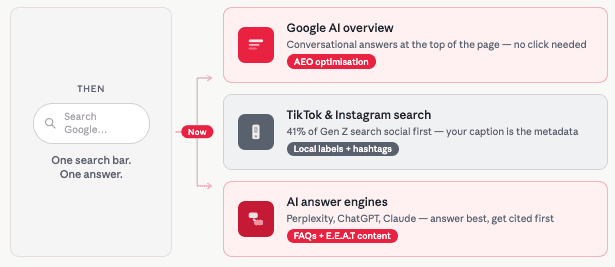
Then Vs. Now: One question from a Kiwi customer; three places they might find the answer. Is your business visible in all three?
Beating the AI Slop: Why Being Human is Your Secret Weapon
We have clients who ask us repeatedly if it is okay to simply post a blog or page content they created using ChatGPT or Gemini (a couple of the many LLM tools out there), and we say no, not by our standards.
To be clear, there is no proof that AI-created content performs poorly in search engines because the bots are focusing on the quality of the content, not how you produced it. So, Google does not punish this yet, but your human users will. We no longer search for information online only to be satisfied with a textbook answer: finding a result like that will leave us wanting more and, ultimately, we bounce from the website.
We are becoming more and more accustomed to finding high-quality content and tools online that not only answer our questions but solve our problems. Though your content ideas may come from AI, it is imperative that you apply E.E.A.T. This is where you exhibit your human experience, expertise, double down on your authority, and build trust.
The Human Edge: AI can describe a “typical” New Zealand winter, but it cannot share the specific story of how your business helped a local client in Southland during a storm. That lived experience is your secret weapon.
Online users crave content that has local context: referring to a place they are familiar with, using slang, or even commenting on the weather. Most importantly, assert your topical authority and be the go-to in your market. Speak like a human being: stay relatable and let your personality shine through.
The Social Search Flip: Using TikTok and Instagram as Your New Google
The second hurdle is that people under 30 (and increasingly everyone else) are no longer turning exclusively to Google for recommendations; they are going to social media platforms, namely Instagram and TikTok. Social media is no longer just for brand awareness: it has become a library of answers.
There is a clear shift amongst Gen Z to using more diverse platforms and search engines to find information. According to the Sprout Social 2026 Strategy Report, nearly 41% of Gen Z users now turn to social media first when looking for information, effectively bypassing Google for discovery-based queries.
Because users now treat these platforms as search engines, the way we create content for them has to change. It is not enough to just post a pretty clip and hope for the best. You have to realise that the “vibe” of a video is for the human, but the caption is for the bot. While the visual might stop the scroll, it is the text underneath that does the heavy lifting.
This text acts as metadata: the hidden layer of labels, keywords, and descriptions that tells an algorithm exactly what your content is about. If you do not use clear, descriptive words in your captions, the Answer Engine inside TikTok will not know you exist. You have to stop writing cryptic, one-word captions and start providing the metadata the algorithm needs to recommend you to a local customer.

Winning the “Answer” Game: Getting to the Top of the Page
Search in Google is increasingly “clickless.” Modern Answer Engines (such as Google’s AI Overviews or Perplexity) look for direct, succinct answers to serve up to users. If you search online regularly, you will be very familiar with the responses that appear at the very top of the page. These look like conversational text that responds to every detail of your query without you ever having to click through to a website.
To show up in these responses, you must be able to accommodate Query Fan-out: having the ability to carry on an online conversation and answer the next question your user might have. Implement clear “Question and Answer” sections (commonly known as FAQs). If you answer a customer’s question better and faster than anyone else, the AI will respond by citing content from your website. This places a link to your brand either at the end of the answer or among the referenced sources, essentially “pinning” your site to the top of the pile. In the world of AEO, providing the most helpful source is the only way to stay visible.
Making Your Content Click: The Power of Local Labels
You must ensure that every photo, video, and caption you post has a label that tells the internet exactly where you are. This simple addition is a massive quick win: it significantly improves the chances of your local community finding you.
To do this effectively, you need to use specific location tags. For example, if Conversion Marketing wants to be known as the best agency in our area, we would optimise our content with the phrase “best digital marketing agency in Auckland” instead of just “best digital marketing agency.”
You want to place these local labels in the very first sentence of your social media caption. This ensures the Answer Engines categorise your post accordingly before a user even clicks “see more.” You must be specific here because this strategy is about being a big fish in the local Kiwi pond rather than getting lost in the global AI ocean.
PRO TIP: Put your city name (like “Auckland” or “Wellington”) in the very first sentence of your post. This helps the “Answer Engines” find you immediately.
Conclusion: Change or Get Left Behind
Online search has become multidimensional (a bit of a multiverse saga, if you will) and is no longer just a static library: it functions as a giant, never-ending conversation. The bottom line is simple: change or get left behind. We are in the age of rapid problem-solving where customers expect solutions with a single touch.
To win, you have to play the game on multiple fronts. Use AI tools combined with your genuine humanity to defeat the “slop,” engage social media users with high-energy video, and anchor every asset with local metadata. Stop using generic text and basic keywords. Instead, arm yourself with direct answers to the questions your customers are actually asking. If you embrace this current search reality, you will find that “a good beginning makes a good ending.”
Ready to stop being a ghost in the machine?
The shift from Search to Answer Engines is a lot to take in, but you do not have to navigate it alone. We have put together a practical guide to help you audit your content and optimise your presence for the local market.